Almost every student pilot remembers the first time they pressed the transmit button: a sentence rehearsed ten times, a dry mouth, and a controller who answered faster than expected. The good news is that VFR radio phraseology is not a talent, it is a small, rule-based language. Once you know its structure, its standard words and its read-back rules, it becomes routine. It also has its own paper in the EASA PPL theory exam, Communications, which is usually short, so every question carries real weight.
Learn the phonetic alphabet and the number pronunciation, the message structure (who you call, who you are, what you want), the abbreviated call sign rule (only after the ground station uses it), the mandatory read-back list in SERA.8015(e) (runway instructions, altimeter settings, SSR codes, frequencies, level, heading, speed), the standard words of SERA Table S14-4, the transponder codes 7600 / 7700 / 7500, MAYDAY and PAN PAN (preferably three times), the VFR radio failure procedure and the aerodrome light signals.
Why Radio Phraseology Matters for the EASA PPL Theory Exam
Under Part-FCL, you need at least 75% in each paper, with no negative marking, and there is no compensation between subjects. The number of questions and the time allowed for each paper are set by your national aviation authority, and Communications is usually one of the shortest papers. With few questions, two or three mistakes can be enough to fail it.
The flip side is that Communications is one of the most “learnable” papers. The syllabus, set out in AMC1 FCL.210; FCL.215, covers VFR communications only: definitions, general operating procedures, relevant weather information terms, action in case of communication failure, distress and urgency procedures, and the basics of VHF propagation and frequency allocation. There are no calculations, and the answers are precise. To see how this paper fits with the other eight, read our guide to the 9 subjects of the EASA PPL(A) theory exam.
The rules themselves come mainly from SERA, the Standardised European Rules of the Air (Regulation (EU) No 923/2012), and in particular its Section 14, voice communication procedures. Your national aviation authority may publish a phraseology manual with local examples, but the core rules are the same across EASA Member States.
The Basics: Alphabet, Numbers and Call Signs
The phonetic alphabet
When letters are spelled out on the radio, SERA.14020 requires the standard spelling alphabet. Note the official spellings: Alfa and Juliett.
| Letter | Word | Letter | Word | Letter | Word |
|---|---|---|---|---|---|
| A | Alfa | J | Juliett | S | Sierra |
| B | Bravo | K | Kilo | T | Tango |
| C | Charlie | L | Lima | U | Uniform |
| D | Delta | M | Mike | V | Victor |
| E | Echo | N | November | W | Whiskey |
| F | Foxtrot | O | Oscar | X | X-ray |
| G | Golf | P | Papa | Y | Yankee |
| H | Hotel | Q | Quebec | Z | Zulu |
| I | India | R | Romeo |
Numbers
SERA.14035 requires each digit to be pronounced separately for aircraft call signs, headings, wind direction and speed, and runways. Flight levels, altimeter settings and SSR codes follow the same principle, with a few hundreds and thousands rules. Typical examples:
- Heading 060: “heading zero six zero”.
- Runway 27: “runway two seven”.
- Squawk 4521: “squawk four five two one”.
- Frequency 118.705: “one one eight decimal seven zero five”. The decimal point is spoken as “decimal”.
- Altitude 2,500 ft: “two thousand five hundred feet”.
The standard pronunciation of some digits is designed to survive a noisy radio: “tree” for 3, “fife” for 5 and “niner” for 9 are the classic examples.
Call signs and abbreviation
A light aircraft uses its registration as its call sign, for example G-ABCD or D-EFGH. The abbreviated form typically keeps the first character and the last two, so D-EFGH becomes “D-GH”. The rule for using it is strict (SERA.14055(c)): an abbreviated call sign is used only after satisfactory communication has been established and when no confusion is likely, and an aircraft uses its abbreviated call sign only after the ground station has addressed it that way. Until the controller abbreviates, you keep your full call sign.
How a Radio Message Is Built
Every call follows the same logic: who you are calling, who you are, and what you want. On first contact with a unit, add what the controller needs to know: aircraft type, position, level or altitude, and intentions. A typical initial call to a tower (fictitious names) could be:
“Riverside Tower, D-EFGH, good morning.”
“D-EFGH, Riverside Tower, go ahead.”
“D-EFGH, DR400, over the town of Millbrook, two thousand feet, inbound for a full-stop landing, information Bravo.”
Three habits make a big difference. Listen before you transmit, so you don’t block someone else’s message. Think before you press the button, so the message comes out in one go. And mention the ATIS letter you have received, so the controller doesn’t need to repeat the weather and runway.
Tip: write your expected calls on your flight log before engine start: reporting points, frequencies and the structure of the first message to each unit. In the air, you just read, and your attention stays on flying the aircraft.
Standard Words and Phrases (SERA Table S14-4)
SERA.14045 gives each standard word a fixed meaning. Exam questions love to contrast them.
| Word | Meaning |
|---|---|
| ACKNOWLEDGE | Let me know that you have received and understood this message |
| AFFIRM | Yes |
| NEGATIVE | No, or permission not granted, or that is not correct, or not capable |
| APPROVED | Permission for proposed action granted |
| ROGER | I have received all of your last transmission |
| WILCO | I understand your message and will comply with it |
| STANDBY | Wait and I will call you |
| UNABLE | I cannot comply with your request, instruction or clearance |
| SAY AGAIN | Repeat all, or the specified part, of your last transmission |
| READ BACK | Repeat all, or the specified part, of this message back to me exactly as received |
| CORRECTION | An error has been made in this transmission; the correct version is… |
Two confusions come up again and again. First, STANDBY is not a clearance: it means wait, nothing more. Second, ROGER is not an answer to a question and does not replace a read-back. A question gets AFFIRM or NEGATIVE; an item on the read-back list gets read back. Another detail: under SERA.14045(c), the expression “TAKE-OFF” is used only when an aircraft is cleared for take-off or when a take-off clearance is cancelled. Before that, you are “ready for departure”, not “ready for take-off”.
Read-Back: What You Must Always Repeat
A read-back lets the controller check that you understood correctly. Under SERA.8015(e), the controller listens to it and corrects any discrepancy immediately. The following items must always be read back:
- ATC route clearances;
- clearances and instructions to enter, land on, take off from, hold short of, cross, taxi and backtrack on any runway;
- the runway in use, altimeter settings, SSR codes, newly assigned communication channels, level instructions, heading and speed instructions;
- transition levels, whether issued by the controller or contained in ATIS broadcasts.
Other clearances or instructions, including conditional clearances and taxi instructions, are read back or acknowledged in a way that clearly shows they have been understood and will be complied with. End every read-back with your call sign, so the controller knows who answered.
| Controller | Correct read-back |
|---|---|
| ”D-GH, wind 250 degrees 8 knots, runway 27, cleared to land" | "Runway 27, cleared to land, D-GH" |
| "D-GH, hold short runway 27" | "Holding short runway 27, D-GH" |
| "D-GH, squawk 4521" | "Squawk 4521, D-GH" |
| "D-GH, QNH 1018" | "QNH 1018, D-GH" |
| "D-GH, contact Riverside Information 119.605" | "Riverside Information 119.605, D-GH” |
Notice that the wind is not on the mandatory list, while the runway and the landing clearance are. That distinction is a favourite exam question.
A Complete Example: Departure from a Controlled Aerodrome
Here is a typical departure, with fictitious names. Watch which items are read back.
“Riverside Ground, D-EFGH, DR400 at the flying club apron, information Charlie, local flight to the south, request taxi.”
“D-EFGH, taxi to holding point runway 27 via Alfa, QNH 1015.”
“Taxi to holding point runway 27 via Alfa, QNH 1015, D-EFGH.”
The runway and the altimeter setting are read back. After the power checks:
“Riverside Tower, D-EFGH, holding point runway 27, ready for departure.”
“D-EFGH, line up and wait runway 27.”
“Lining up and waiting runway 27, D-EFGH.”
“D-GH, wind 260 degrees 6 knots, runway 27, cleared for take-off.”
“Runway 27, cleared for take-off, D-GH.”
The controller has now abbreviated the call sign, so the pilot may use “D-GH” from that point on.
Language and Language Proficiency
Under SERA.14015, air-ground communications are conducted in English or in the language normally used by the station on the ground. English must be available on request at stations serving designated aerodromes and routes used by international air services, and the languages available at each station are published in the national AIP.
Separately from the theory exam, FCL.055 requires pilots who use the radio telephone to hold a language proficiency endorsement, in English or in the language used for radio communications on the flight. The minimum is Level 4 (operational), re-evaluated every 4 years; Level 5 is re-evaluated every 6 years, and Level 6 needs no re-evaluation. Your training organisation will tell you how this is assessed in your country.
Radio Failure, Distress and Urgency
Transponder codes
| Code | Meaning (SERA.13005) |
|---|---|
| 7700 | Emergency |
| 7600 | Radio communication failure |
| 7500 | Unlawful interference |
VFR radio failure procedure
Since 1 May 2025, the radio failure procedures are in SERA.14083. The aircraft sets code 7600, and a VFR flight continues to fly in visual meteorological conditions, lands at the nearest suitable aerodrome and reports its arrival by the most expeditious means to the appropriate air traffic services unit. Older textbooks may quote the earlier article numbers; the procedure for VFR is the same.
MAYDAY and PAN PAN
Under SERA.14095, a distress message starts with MAYDAY and an urgency message with PAN PAN, each preferably spoken three times. Distress means grave and imminent danger requiring immediate assistance; urgency means a condition concerning the safety of the aircraft or someone on board that does not require immediate assistance. Transmit on the frequency in use first: that station already knows you. 121.5 MHz is the aeronautical emergency frequency. Then give, as far as possible, the station addressed, your call sign, the nature of the problem, your intentions, position, level and heading.
Light signals from the tower
If your radio fails near a controlled aerodrome, the tower can use a signal lamp. The meanings come from SERA Appendix 1.
| Signal | Aircraft in flight | Aircraft on the ground |
|---|---|---|
| Steady green | Cleared to land | Cleared for take-off |
| Steady red | Give way to other aircraft and continue circling | Stop |
| Series of green flashes | Return for landing | Cleared to taxi |
| Series of red flashes | Aerodrome unsafe, do not land | Taxi clear of landing area in use |
| Series of white flashes | Land at this aerodrome and proceed to apron | Return to starting point on the aerodrome |
| Red pyrotechnic | Notwithstanding any previous instructions, do not land for the time being | No meaning |
To acknowledge in flight by day, rock the wings, except on base and final. On the ground by day, move the ailerons or rudder. At night, flash the landing lights twice, or the navigation lights if there are no landing lights.
Classic Exam Traps
- STANDBY taken as permission: it is neither approval nor refusal.
- Abbreviating your call sign too early: wait for the ground station to do it first.
- Forgetting to read back an altimeter setting or squawk: both are on the mandatory list.
- Reading back the wind: not required; the runway and clearance are.
- Green flashes vs steady green: in flight, steady green clears you to land; green flashes mean return for landing.
- 7600 vs 7700: 76 for radio failure, 77 for emergency.
- “Ready for take-off”: use “ready for departure”; “take-off” is reserved for the clearance itself.
How to Study Communications Effectively
Communications is built on short rules and lists, exactly the kind of material that fades if you don’t revisit it and sticks if you review it at the right moment. Three methods work well:
- Flashcards: one card per standard word, transponder code and light signal. Spaced repetition brings each one back just before you would forget it, and ten minutes a day is enough.
- Saying calls out loud: read typical exchanges aloud. Your mouth gets used to the phrases, which pays off in the cockpit too.
- Timed practice papers: practise short, timed sets of questions so the pressure of the pass mark feels normal on exam day.
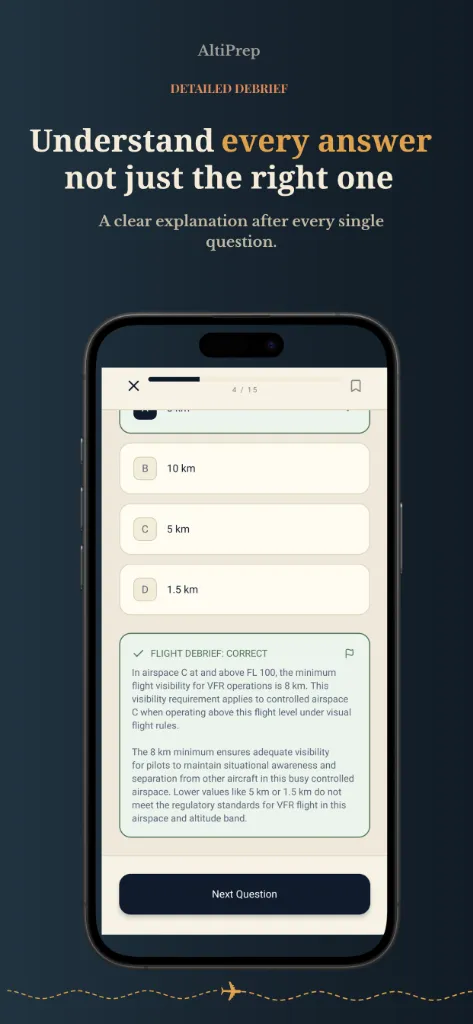
With AltiPrep, you can practise exam-style Communications questions with an explanation for every answer, drill the alphabet, codes and light signals with spaced-repetition flashcards, and track your progress through full mock exams. To fit this into a wider plan, see our guide on how to pass the EASA PPL theory exam first time, then the day-by-day plan for the last week before the exam.
Key Takeaways
- Communications is usually a short paper: you need 75%, and each mistake costs a lot. Question counts and timings come from your national aviation authority.
- Use the standard alphabet, pronounce each digit separately for headings, runways, wind and squawks, and abbreviate your call sign only after the ground station does.
- Always read back runway clearances and instructions, altimeter settings, SSR codes, frequencies, level, heading and speed instructions, and transition levels (SERA.8015(e)).
- ROGER means received, WILCO means will comply, STANDBY means wait.
- 7700 emergency, 7600 radio failure, 7500 unlawful interference; MAYDAY and PAN PAN preferably three times.
- VFR radio failure: stay in VMC, land at the nearest suitable aerodrome, report your arrival.
Further reading:
- The 9 Subjects of the EASA PPL(A) Theory Exam Explained
- How to Pass the EASA PPL Theory Exam First Time: The Complete 2026 Guide
- The Last Week Before Your PPL Theory Exam: A Day-by-Day Plan
- Spaced Repetition: The Most Effective Way to Study for Your EASA PPL Exam
Happy studying, and see you on frequency!
Frequently asked questions
What must a pilot always read back under SERA?
SERA.8015(e) lists ATC route clearances; clearances and instructions to enter, land on, take off from, hold short of, cross, taxi and backtrack on any runway; the runway in use, altimeter settings, SSR codes, newly assigned communication channels, level, heading and speed instructions; and transition levels. Other clearances, including conditional clearances and taxi instructions, must be read back or acknowledged so that it is clear they have been understood.
When can I use an abbreviated call sign?
Only after satisfactory communication has been established, when no confusion is likely, and only after the ground station has addressed you with the abbreviated call sign first. Until then, keep using your full call sign. If another aircraft has a similar call sign, go back to the full form.
What is the difference between ROGER and WILCO?
ROGER means ’I have received all of your last transmission’. WILCO means ’I understand your message and will comply with it’. Neither replaces a read-back when the item is on the mandatory read-back list, and ROGER is never an answer to a question.
What should I do after a radio failure in VFR?
Set transponder code 7600. Under SERA.14083, a VFR flight continues to fly in visual meteorological conditions, lands at the nearest suitable aerodrome and reports its arrival to the appropriate air traffic services unit by the most expeditious means. Near a controlled aerodrome, watch the tower for light signals.
How many questions are in the EASA PPL Communications paper?
The number of questions and the time allowed are set by your national aviation authority, so check the figures it publishes. What EASA sets is the pass mark: at least 75% in each paper, with no negative marking. Because the Communications paper is usually short, each wrong answer costs a lot.
Do I need an English language proficiency endorsement for the PPL?
Under FCL.055, pilots who use the radio telephone need a language proficiency endorsement in English or in the language used for radio communications on the flight. The minimum is Level 4, which is re-evaluated every 4 years; Level 5 every 6 years; Level 6 has no re-evaluation. It is separate from the theory exam.