Your exam is booked, months of study are behind you, and there are seven days left. This is usually when doubt creeps in: should you reread everything, grind practice questions until midnight, or ease off? The last week before your PPL theory exam is not for learning new material. It is for turning what you already know into marks on the day. Here is a practical, day-by-day plan to walk into the exam room rested, clear-headed and confident.
At T-7, take an honest snapshot with a timed mock exam for every paper you are sitting. If you are well short of 75%, postpone rather than waste an attempt. Then target your weak topics, drill calculations and key figures, keep your daily flashcards, sit a final mock at T-2, and ease off at T-1. On the day, manage your time, read every question to the end and never leave an answer blank.
Why the Last Week Before the PPL Theory Exam Matters
Nobody learns the EASA PPL syllabus in seven days. If you are reading this a week before your exam, most of the work is done. Yet the final week has an outsized effect on the result, for three reasons.
First, the pass mark applies to every paper. You need 75% on each of the 9 subjects, with no compensation between them. One neglected subject is enough to send you back for a resit. The last week is the ideal moment to find that weak paper and bring it up to standard.
Second, memory fades. Topics you studied two months ago may have partly slipped away if you have not kept them alive. A few days of targeted revision is often enough to bring them back, as long as you know which ones need it.
Third, your condition on the day counts. A tired candidate misreads questions, misses negatives and makes arithmetic slips. A well-run final week is also a week in which you sleep properly and arrive with a clear head.
If you are still building your overall study plan, start with our guide on how to pass the PPL theory exam first time, which includes a 12-week schedule. This article picks up for the final seven days.
The Rules to Keep in Mind
Before you plan the week, remember the framework set by the EASA aircrew rules (Part-FCL):
| Rule | What it means for your final week |
|---|---|
| 75% on each paper | Every subject must be ready, not just your average |
| No negative marking | Never leave an answer blank |
| 4 attempts per paper | A wasted attempt has a real cost |
| 18 months to pass all papers | Counted from the end of the calendar month of your first attempt |
| Same national authority for all papers | Practise with the format that authority publishes |
| Questions and timing per paper | Set by your national aviation authority |
The last line matters more than it looks. Because each national authority sets the number of questions and the time allowed, your margin depends on the length of each paper. On a 20-question paper, 75% lets you miss 5 questions. On a 12-question paper, you can only miss 3. On an 8-question paper, just 2. Check the format your authority publishes and work out your margin for each paper: one poorly understood topic can be enough to sink a short paper. For a reminder of what each subject covers, see our guide to the 9 subjects of the EASA PPL(A) theory exam.
T-7: The Honest Snapshot
The first day of the final week is the most important. Your goal is to know exactly where you stand, subject by subject.
Sit One Mock Exam per Paper
For every paper you are about to sit, take one mock exam in real conditions: the official number of questions, a timer, no notes, phone in flight mode. If you are sitting all 9 subjects, spread them across T-7 and T-6 so you do not burn out.
Record your score, but above all record every question you got wrong and the topic it belongs to. A mock exam is not a grade: it is a diagnosis.
Read Your Results Through the Right Filter
| Your mock exam score | What it means | Decision |
|---|---|---|
| 85% or more, consistently | A comfortable margin for exam-day nerves | Keep the date, maintain |
| Between 75% and 85% | Just above the line | Keep the date, but target weak topics |
| Around 75% or below | The slightest stress could tip you under | Seriously consider postponing |
| Wildly different from one try to the next | Fragile knowledge, or luck | Go back to the theory before deciding |
The 85% figure is not an official rule: it is a safety margin. On the day, stress, a misread question or unfamiliar wording can cost you a few marks. If you are already on the edge in comfortable conditions, you are taking a real risk.
Postponing Is Not Failing
This is the decision many candidates put off, even though it is often the most rational one. A used attempt and a failed paper cost more, in time and morale, than a few extra days of preparation. Booking and cancellation rules depend on your national authority and exam centre, so check them early. Talk it through with your instructor or with your DTO or ATO as well: an outside view is valuable.
The Day-by-Day Plan
Here is a typical plan for a week in which you are sitting several papers. Adapt it to your schedule: if you work full time, think one to two hours each evening rather than whole days.
| Day | Goal | Activities |
|---|---|---|
| T-7 | Diagnosis | Timed mock exams, log of mistakes |
| T-6 | Diagnosis and triage | Remaining mocks, sort weak topics by type |
| T-5 | Weak topics (1) | Back to the theory on your two weakest topics, targeted questions |
| T-4 | Calculations | Navigation, mass and balance, fuel, performance |
| T-3 | Weak topics (2) and key figures | Remaining topics, one-page sheet of figures to know |
| T-2 | Validation | Final full mock exam, review of mistakes |
| T-1 | Ease off | Mistake log, flashcards, logistics, rest |
| Exam day | Execution | Arrive early, manage time, no blank answers |
On top of this, keep 15 to 20 minutes of flashcards every day. That is what stops your strong subjects from fading while you work on the weak ones.
T-6 and T-5: Back to the Theory, Not the Questions
Faced with a topic you got wrong, the natural reflex is to repeat questions on it until you get them right. That is a trap: you end up recognising the questions without understanding the concept. Go back to the theory first. Reread the chapter, redraw the diagram, explain the idea out loud. Only then do more questions, ideally ones you have never seen.
Sort your weak topics into three types:
- Not understood: you cannot explain the mechanism (for example, why stall speed rises with load factor). Top priority: back to the theory.
- Forgotten: you understood it once, but the figure or rule will not come back (for example, a VMC minimum). Flashcards and summary sheets.
- Misread: you knew the answer but read the question wrongly. Work on reading technique, not on content.
T-4: Calculation Day
Calculations are the most reliable marks in the exam: once the method is solid, there is no doubt about the answer. They are also the questions that eat the most time when the method is shaky. Give them a full day:
- Navigation: true and magnetic tracks, time and distance, the 1 in 60 rule, the wind triangle.
- Mass and balance: moments, centre of gravity position, checking against the envelope.
- Fuel: consumption, fuel required, volume and mass conversions.
- Performance: reading take-off and landing charts, the effect of density altitude.
The goal on T-4 is not speed but automation. If you have to think about the method, repeat the exercise until it becomes obvious.
T-3: Key Figures
Air Law and Communications rely heavily on precise details: airspace classes, minima, phraseology, right of way, validity periods. These questions are won or lost in a second. Build a single sheet of key figures to reread on T-1 and on the morning of the exam. Simply writing it forces you to check what you really know.
T-2: The Final Mock
Sit one more full mock exam for each paper, ideally with different questions from T-7. Compare your scores. Progress confirms that the week has paid off. A drop should make you stop and think: fatigue, a topic still fragile, or simple variation. If in doubt, review the mistakes using the same method as on T-6.
Tip: after every mock exam, keep a mistake log with three columns: the question in a few words, the correct answer, and above all why you got it wrong. Read on T-1, this log is the highest-value revision of the whole week, because it contains only what actually caught you out.
Using Mock Exams the Right Way
Mock exams are the central tool of the final week, yet they are often misused. Three simple rules.
Real conditions, no exceptions. Timer running, no notes, no pausing to check an answer. A mock taken with the textbook open gives you a flattering and useless score.
Fresh questions. If you have been repeating the same sets for weeks, you are measuring your memory of the questions, not your command of the syllabus. Vary your sources and question draws.
The review is worth more than the score. Spend at least as long reviewing a mock as taking it. For each mistake, understand why the right answer is right and why the others are wrong. Treat every lucky guess as a mistake.
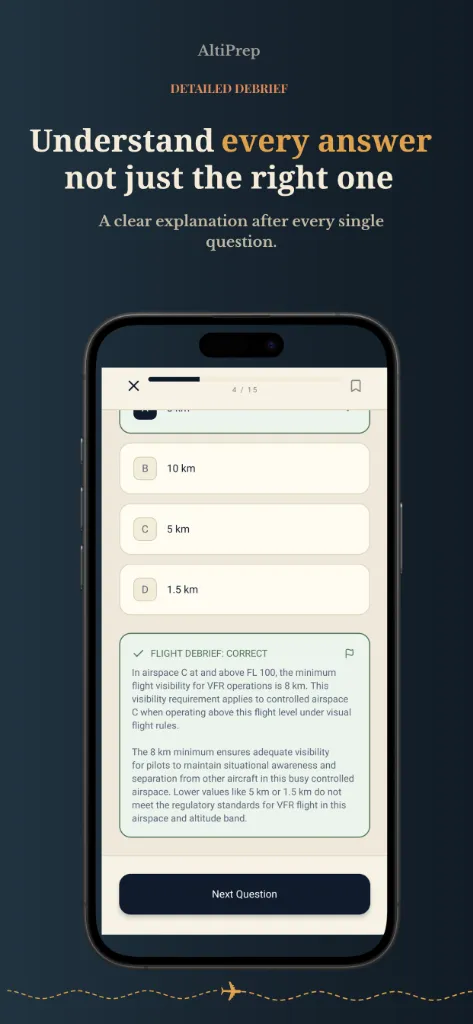
With AltiPrep, you can run timed mock exams subject by subject, track your scores from one attempt to the next and revisit every mistake with its explanation. Spaced-repetition flashcards take care of the figures you need to remember.
The Day Before: Ease Off Without Switching Off
The day before is not the time for a final question marathon. Your brain needs to consolidate what you have worked on, and sleep plays an important role in consolidating memory. A typical day before looks like this:
- Morning: reread your mistake log and your key figures sheet.
- Afternoon: a short flashcard session, then stop.
- Logistics: check your exam confirmation (venue, time, documents and equipment allowed), prepare your photo ID, plan the journey with a margin.
- Evening: something calm, a light meal, bed at your normal time.
Do not start a new mock exam the day before. A poor score a few hours before the exam would teach you nothing useful and could dent your confidence.
Exam Day: Managing Time and Reading Carefully
On exam day, most marks are lost to inattention, not ignorance. A few habits make the difference.
Arrive early. Settle in calmly. The first minutes of a paper are when stress causes the most reading errors.
Know your pace. Divide the time allowed by the number of questions for each paper so you know your average per question before you start. Knowledge questions take seconds, which frees up time for calculations. If a question blocks you, move on and come back if the exam software allows it.
Read every question to the end. The classic traps:
- a negative (“which of the following is NOT…”);
- an unexpected unit (feet instead of metres, knots instead of km/h, litres instead of kilograms);
- a word that changes everything (“always”, “never”, “at least”);
- a reference: magnetic or true, altitude or height.
Never leave an answer blank. With no negative marking, a guess is always worth more than an empty box.
Do not change an answer without a reason. Your first reading is often right. Only change an answer if you have spotted a specific detail you missed.
If You Sit the Papers Over Several Sessions
Because each subject is a separate paper, many students sit them in blocks. In that case, the “final week” repeats before each session, but only for the subjects in that block. Two points to watch:
- Do not drop the subjects you have already passed. They will not be examined again, but you need them in the aircraft and for your skill test. A few flashcards a week keep them alive.
- Watch the calendar. The 18-month window runs from the end of the calendar month of your first attempt. Do not leave long gaps between blocks.
Common Final-Week Mistakes
- Opening a chapter you never studied. A week out, it is better to consolidate what you know at 70% than to skim an unknown topic.
- Repeating the same questions in a loop. You end up recognising questions without mastering the concepts.
- Dropping your flashcards. When you focus on one subject, the others fade. Spaced repetition protects what you have already learned.
- Sacrificing sleep. A short night costs more marks than an extra hour of study earns.
- Ignoring a borderline score. If your mocks keep landing around the pass mark, keeping the date out of pride is a risky bet.
- Neglecting logistics. An unread confirmation, a forgotten ID, a badly timed journey: avoidable errors that add needless stress.
Key Takeaways
- The final week is for consolidation and getting into shape, not for new chapters.
- At T-7, sit a timed mock for each paper: 85% or more consistently gives a comfortable margin; around 75%, consider postponing.
- For each weak topic, go back to the theory before doing more questions, and give calculations a full day.
- Keep 15 to 20 minutes of flashcards a day and a mistake log to reread the day before.
- On the day before, ease off, sort the logistics and sleep. On exam day, read every question to the end and never leave a blank.
Further reading:
- How to Pass the EASA PPL Theory Exam First Time: The Complete 2026 Guide
- The 9 Subjects of the EASA PPL(A) Theory Exam Explained
- Spaced Repetition: The Most Effective Way to Study for Your EASA PPL Exam
- How to Study for the PPL Theory Exam While Working Full Time
Happy flying and good luck with your revision!
Frequently asked questions
What should I revise in the last week before the PPL theory exam?
Focus on the weak topics your mock exams revealed, on the figures you must know by heart and on calculation methods. The final week is for consolidation, not for opening chapters you have never studied. Keep a short daily flashcard session to maintain everything else.
How many mock exams should I do before the PPL theory exam?
In the final week, two or three timed mock exams for each paper you are sitting is usually enough. What matters is the review: every mistake should be understood and worked on. If your scores stay close to 75%, postponing is usually wiser than using up an attempt.
Should I study the day before the PPL theory exam?
A light review is useful: go through your mistake log and a few flashcards, then stop by late afternoon. Avoid new mock exams and late-night cramming, which tire you without adding much. A good night’s sleep will do more for your score than another hour of questions.
Can I postpone my PPL theory exam if I am not ready?
In most cases, yes, and it is often the smartest decision if your mock exam scores are not where they should be. Booking and cancellation rules depend on your national aviation authority and exam centre, so check them as soon as you book. Talk it through with your instructor or your DTO or ATO as well.
How many mistakes can I make on a PPL theory paper?
You need at least 75% on each paper, with no negative marking. The number of questions per paper is set by your national aviation authority, so the margin depends on the paper length: on a 20-question paper you could miss 5, on a 12-question paper only 3. Work out your margin for each paper before exam day.
What happens if I fail a paper despite my preparation?
You only resit that paper. Under Part-FCL you have up to 4 attempts per paper, and all papers must be passed within 18 months from the end of the calendar month of your first attempt. Use your result to target the topics you missed before the next attempt.