You work all week, you fly on Saturdays when the weather allows, and somewhere in between you are supposed to master 9 subjects? That is the situation of most private pilot students, and the good news is that it is very manageable. Studying for the PPL theory exam while working full time does not take whole evenings. It takes a simple system: short, regular sessions, a sensible order of subjects and exam dates booked at the right moment. This guide gives you a practical method, a 6-month plan and the traps to avoid when time is tight.
Aim for 20 to 40 minutes a day on weekdays plus one longer weekend session, rather than big irregular blocks. Study the 9 subjects in blocks of 2 or 3 and sit each block as soon as it is ready. Use dead time (commutes, lunch breaks) for flashcards and practice questions, and keep calculations for a quiet moment. Plan on 4 to 6 months overall. During busy weeks, switch to a minimum mode (10 minutes of flashcards) instead of stopping.
Studying for the PPL Theory Exam While Working: Is It Realistic?
Yes, and the way the exams are organised helps you. Under the EASA rules (Part-FCL), the PPL(A) theory is split into 9 subjects, each tested by its own multiple-choice paper. You need at least 75% on every paper, and the papers can be taken over several sittings: you do not need to be ready on the whole syllabus at the same time.
For someone with a job, that is a real advantage. You can work subject by subject, sit two or three papers as soon as they are solid, then move on to the next block. The rules give you room, as long as you know them:
| Rule | What it means for your schedule |
|---|---|
| 📋 9 subjects, one paper each | You can split your preparation into blocks |
| ✅ 75% on each paper | Every subject must be solid, with no averaging |
| 🔁 4 attempts per paper | A fail is not the end, but every attempt counts |
| 📅 18 months to pass them all | The clock starts at the end of the month of your first attempt |
| ⏳ 24 months of validity | Once all papers are passed, you have 24 months for the skill test |
The number of questions and the time allowed per paper are set by your national aviation authority, so check its published format before you start timed practice.
The rule to watch is the 18-month window. It does not start when you join a flying school, but at the end of the calendar month of your first exam attempt. When you work, it is tempting to sit one paper very early “to get started” and then let the rest drift. It is better to have a clear view of the whole journey before you sit that first paper. For the full rules and format, read our guide on how to pass the EASA PPL theory exam first time.
How Much Time Do You Need With a Full-Time Job?
There is no official figure: it depends on your starting point, your availability and how consistent you are. As a rough guide, here are realistic timeframes for a working adult:
| Pace | Indicative duration | Our view |
|---|---|---|
| 45 to 60 min a day + 2 h at the weekend | 3 to 4 months | Effective, but hard to sustain |
| 20 to 40 min a day + 1 to 2 h at the weekend | 4 to 6 months | ⭐ The best balance for most working students |
| Weekends only | 6 months or more | Not recommended: you forget a lot from one week to the next |
The weekends-only approach looks convenient, but it gives the worst return. Between two sessions you forget a good part of what you covered, so every Saturday starts with catching up. For the same total time, five 25-minute sessions achieve far more than one 2-hour session.
Do not set an overly ambitious target either. A 3-month plan that collapses after 3 weeks is more discouraging than a 6-month plan you actually follow. Choose a pace you are sure you can keep during a busy week, not during an ideal one.
The Golden Rule: Short, Regular Sessions
When time is short, people tend to wait for “the right moment”: a free evening or a whole Sunday. That moment rarely comes. The method that works is the opposite: short, almost daily sessions, built into slots that already exist in your day.
This approach has a second benefit: it works with the way memory works. Reviewing a topic several times, at increasing intervals, makes it stick far better than one long reading session. That is the principle of spaced repetition, which is especially useful for subjects full of rules and figures such as Air Law and Communications.
In practice, an effective 25-minute session can look like this:
- 5 minutes of flashcards to review the cards due that day;
- 15 minutes on your current subject: one section of theory or a set of practice questions;
- 5 minutes reviewing mistakes from that set, noting anything you did not understand.
This fits in a lunch break, and it builds both memory and understanding.
💡 Tip: attach your session to a fixed point in your day (the coffee after lunch, the train home, the moment the kids are in bed). A habit linked to something you already do needs far less willpower than a slot you have to “find” every day.
Finding Time in a Busy Week
Not all slots are equal. The idea is to match each kind of task to the moment that suits it:
| Slot | Typical length | Best activity |
|---|---|---|
| 🚆 Commute | 10 to 30 min | Flashcards, short question sets, reviewing mistakes |
| 🥪 Lunch break | 15 to 25 min | A full session: flashcards + questions on your current subject |
| 🌙 Weekday evening | 20 to 40 min | Reading theory, understanding new topics |
| 🏡 Weekend | 1 to 2 h | Calculations (navigation, mass and balance, performance), mock exams |
| ☁️ Flight cancelled for weather | Varies | Study session at the club: catch up on a chapter, prepare the next lesson |
Calculations deserve special attention. A wind triangle, fuel or mass and balance problem takes concentration, paper and often a flight computer or calculator. It is not something to do standing on a train. Keep these for the weekend or a quiet evening, and practise the method until it becomes automatic. Our guides to the wind triangle and mass and balance walk you through both step by step.
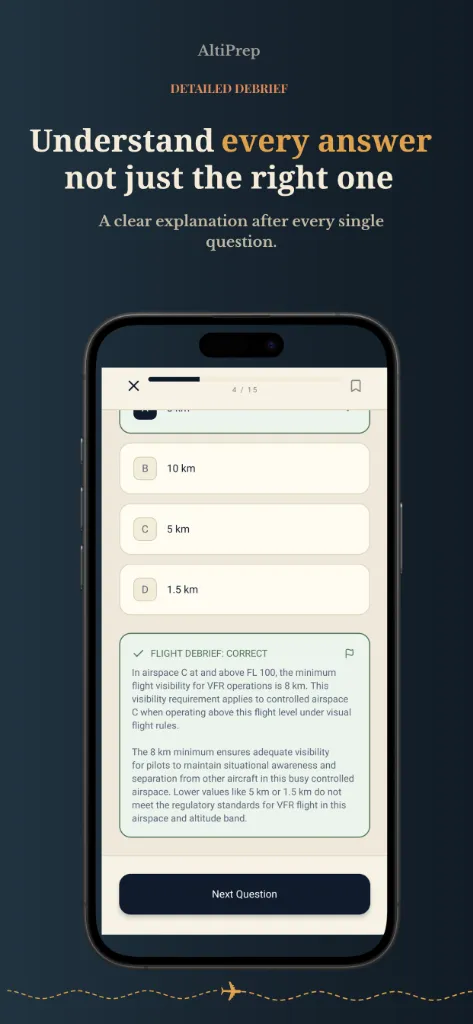
Flashcards and short question sets, on the other hand, are perfect for dead time. With an app like AltiPrep, you can run through a set of questions or your daily cards in a few minutes on your phone and pick up exactly where you left off. Your progress in each subject is tracked automatically, so you do not need to keep a spreadsheet.
In What Order Should You Study and Sit the 9 Papers?
Studying all 9 subjects in parallel is the surest way to lose focus, especially when time is limited. Work in blocks of 2 or 3 subjects, in an order that follows your flight training. This split works well for many students:
| Block | Subjects | Type of work | Why this order |
|---|---|---|---|
| 1 | Principles of Flight, Aircraft General Knowledge | Understanding | Supports your first lessons: stalls, engine, instruments |
| 2 | Navigation, Meteorology | Understanding + calculations | Two big subjects, useful from your first cross-country flights |
| 3 | Air Law, Communications, Operational Procedures | Memorisation | Lots of facts: ideal for daily flashcards |
| 4 | Flight Performance and Planning, Human Performance | Calculations + synthesis | Brings everything together, right before solo cross-country |
This order is not compulsory. If your instructor plans cross-country flights earlier, move block 2 forward. If you already know engines well, block 1 will go faster. What matters is to finish one block before starting the next, while keeping the flashcards from earlier blocks going so you do not forget them.
Watch out for the smaller subjects. With 75% required on every paper, a short paper leaves very little room: a handful of wrong answers can mean a fail. An “easy” subject that you skimmed can cost you an attempt. For what each subject covers, see The 9 Subjects of the EASA PPL(A) Theory Exam Explained.
A Sample 6-Month Study Plan
Here is an example plan for a pace of 20 to 40 minutes a day on weekdays and 1 to 2 hours at the weekend. Adapt it to your constraints, but keep the logic: one block at a time, and sit the papers as soon as the block is ready.
| Period | Goal | By the end |
|---|---|---|
| Month 1 | Block 1: Principles of Flight + Aircraft General Knowledge | Mock exams at 85% or more |
| Early month 2 | Sit the block 1 papers | 2 papers passed |
| Months 2 and 3 | Block 2: Navigation + Meteorology (calculations at weekends) | Mock exams at 85% or more |
| Early month 4 | Sit the block 2 papers | 4 papers passed |
| Months 4 and 5 | Block 3: Air Law + Communications + Operational Procedures | Papers sat at the end of month 5 |
| Month 6 | Block 4: Performance + Human Performance, general review | All 9 papers passed |
This plan leaves deliberate slack. With 18 months to pass everything, finishing in about 6 months gives you room to absorb a hard period at work, a holiday or a failed paper without ever being under pressure.
On the admin side, your DTO or ATO must recommend you before you can sit the exams, and all papers must be taken with the same Member State’s authority. Booking procedures and session calendars vary between national authorities, so look them up early: when you work, finding a session that fits your diary can take longer than you expect.
Fitting Theory, Flying and Work Together
Theory and flying progress better together than apart. A few simple habits make each one help the other:
- Read the chapter before the lesson: if your next lesson covers stalls, review Principles of Flight the week before. You will follow the briefing better, and the flight will lock in the theory.
- Make use of cancelled flights: a Saturday with no flying weather can become a study session with your instructor or other students.
- Book papers away from work peaks: avoid month-end closes, launches and business trips. A paper sat while exhausted is a risky attempt.
- Use your leave wisely: a day off before or on exam day is often worth more than a week of half-focused study.
- Share your timeline with your instructor: they can match your flight training to your theory progress, and tell you when they consider you ready to be recommended.
Keep the end of the journey in mind too: once all papers are passed, the result is valid for 24 months for the issue of the licence, so you need to pass your skill test within that time. For a student who mostly flies at weekends that is comfortable, but build it into your flying plan from the start.
Staying Motivated Over Several Months
The biggest risk when you work is not a lack of ability but running out of steam. After the enthusiasm of the first weeks, a busy period arrives, you skip a few days, then a week, and your preparation stops without you ever deciding it. Some ways to prevent that:
- Set a date: book your first sitting as soon as your block 1 scores approach the required level. A date in the diary is the best motivator there is.
- Have a minimum mode: during a very busy week, 10 minutes of flashcards a day is enough to keep the thread. It works far better than stopping completely and starting again later.
- Measure your progress: watching your scores rise subject by subject is very motivating. Track your mock exam results rather than the hours you put in.
- Celebrate each paper passed: 9 papers means 9 small wins. They count.
- Study with other students: a club chat group or a shared session before an exam helps everyone keep the pace.
Common Mistakes Working Students Make
- Waiting until you have time: it never comes. Start with 15 minutes a day rather than waiting for a quieter month.
- Relying on weekends only: you forget too much between sessions, and one busy weekend costs you two weeks.
- Sitting a paper too early “to start the clock”: the 18-month window then starts before the rest of your preparation is organised.
- Doing calculations on the commute: without quiet and the right tools, method errors creep in and stick.
- Stopping completely during busy periods: restarting costs far more than keeping a minimum routine.
- Booking a sitting without mock exams: aim for at least 85% on several recent mock exams before you book, to keep a margin against stress and fatigue.
Key Takeaways
- Studying for the PPL theory exam while working full time is realistic, because the EASA papers are independent and can be passed over several sittings.
- The best pace for most working students: 20 to 40 minutes a day on weekdays plus a longer weekend session, for 4 to 6 months overall.
- Use dead time for flashcards and practice questions, and quiet time for calculations and mock exams.
- Work in blocks of 2 or 3 subjects and sit each block as soon as it is ready, keeping an eye on the 18 months and the 4 attempts.
- During busy weeks, switch to a minimum mode instead of stopping.
Further reading:
- How to Pass the EASA PPL Theory Exam First Time: The Complete Guide
- The 9 Subjects of the EASA PPL(A) Theory Exam Explained
- Spaced Repetition: The Most Effective Way to Study for Your PPL
Happy studying, and blue skies!
Frequently asked questions
Can you study for the PPL theory exam while working full time?
Yes, and most private pilot students do exactly that. Because each EASA PPL subject is tested by its own paper, you can study and sit the exams in blocks that fit around your job. Consistency is what matters most: 20 to 40 minutes a day on weekdays beats one long session on Sunday.
How long does PPL theory take when you have a full-time job?
With 20 to 40 minutes a day on weekdays and a longer session at the weekend, most working students should plan for around 4 to 6 months. This is only a rough guide: your starting point, your workload and how regular you are matter more than the calendar. Track your mock exam scores and only book a paper when you are ready.
Do I have to sit all 9 EASA PPL papers on the same day?
No. EASA rules allow the papers to be passed over several sittings, which suits people who work. Remember that you have 18 months, counted from the end of the calendar month of your first attempt, to pass them all, with a maximum of 4 attempts per paper. Check how your national aviation authority schedules its exam sessions.
In what order should I study the PPL theory subjects?
A good order is to start with Principles of Flight and Aircraft General Knowledge, which support your first flying lessons. Then move on to Navigation and Meteorology, followed by Air Law, Communications and Operational Procedures, and finish with Flight Performance and Planning and Human Performance. Adjust the order to your flight training with your instructor.
What should I do during a very busy week at work?
Switch to a minimum mode instead of stopping completely: 10 minutes of flashcards a day is enough to keep what you have already learnt. A full break of two or three weeks costs far more, because you then have to rebuild what you forgot. Go back to your normal routine as soon as you can.
How can I study for the PPL on my commute?
Commutes are ideal for short tasks that need no paper or calculator: flashcards, short sets of practice questions and reviewing your mistakes. Keep navigation, mass and balance and performance calculations for a quiet moment at a desk, with your flight computer and charts.