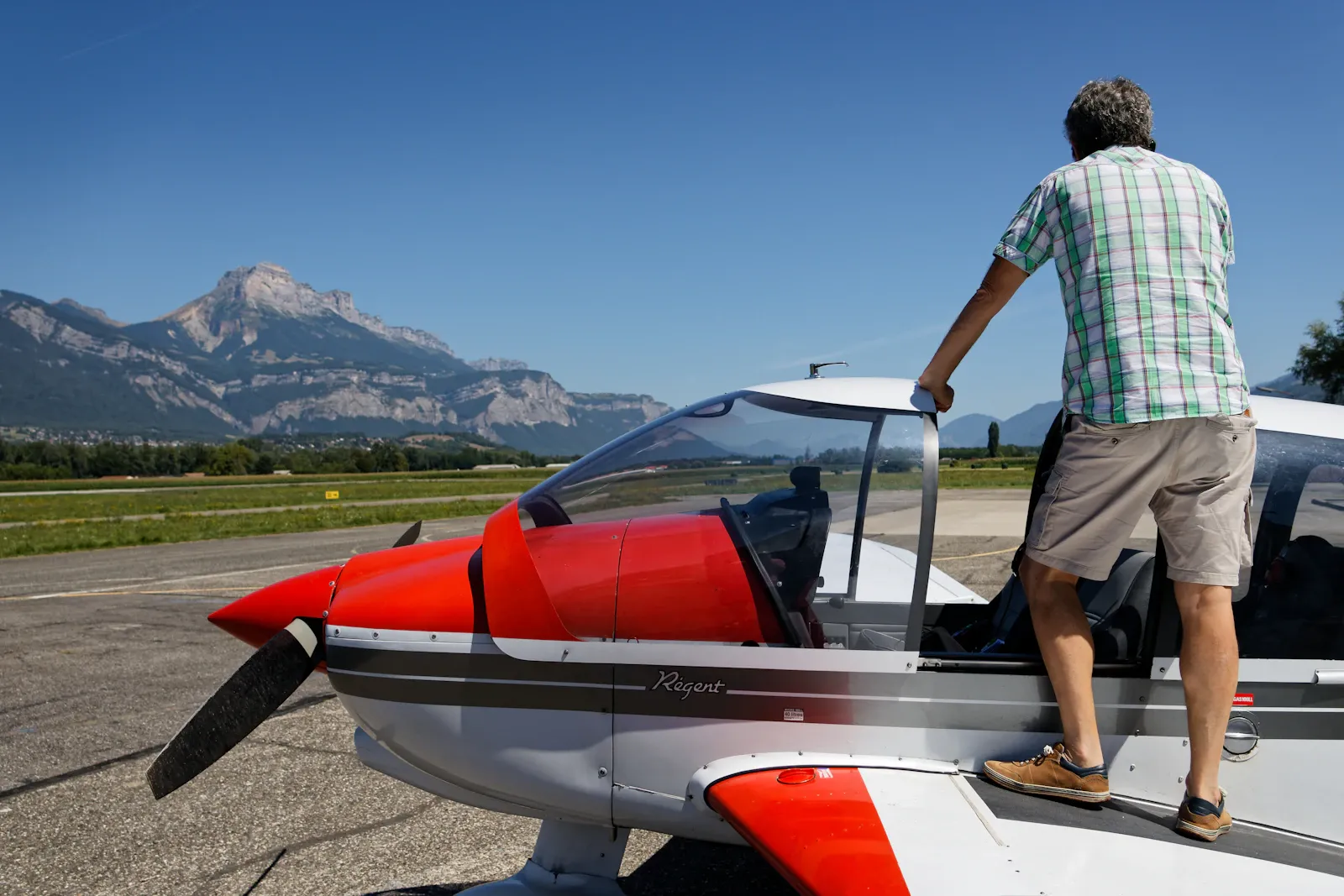
Four adults, their bags and full tanks: on many training aircraft, that load simply does not fit. Mass and balance shapes every flight you will make with passengers. In the EASA PPL theory exam, it is part of Flight Performance and Planning, tested through definitions and, above all, calculations. The good news: the method fits in four steps. This guide walks you through it, with a complete worked example, the effects of a badly placed CG and the classic exam traps.
For every item on board, moment = mass × arm. Add up the masses, add up the moments, and the centre of gravity = total moment ÷ total mass. Two checks follow: the mass must not exceed the maximum mass (for take-off and for landing), and the CG must stay between the forward and aft limits of the flight manual. An aft CG makes the aircraft unstable and dangerous in a stall, a forward CG makes it heavy in pitch and raises the stall speed. Fuel (about 0.72 kg per litre of avgas) moves the CG as it burns.
Why Mass and Balance Matters (Not Just for the Exam)
An aircraft is certified for a range of masses and centre of gravity positions: outside it, its behaviour has not been tested. EASA’s operating rules for non-commercial flights in light aircraft (Part-NCO) require the loading, the mass and the CG position to comply with the flight manual limitations during every phase of the flight. That is the pilot-in-command’s responsibility, which means yours from your very first flight with passengers.
There are two separate questions:
- Mass: is the aircraft too heavy? Excess mass lengthens the take-off run, reduces the climb rate, raises the stall speed and loads the structure beyond what it was designed for.
- Balance: where is the centre of gravity (CG), the point through which the aircraft’s weight acts? Even at a legal mass, a badly placed CG can make the aircraft unstable or impossible to flare.
So an aircraft can be within the mass limit but out of balance: examiners love that case.
The Vocabulary You Need
These flight manual terms come up most often in exam questions:
| Term | Definition |
|---|---|
| ⚖️ Basic empty mass | The mass of the aircraft as weighed, with its fixed equipment. It usually includes unusable fuel and oil, depending on the definition used by the manual |
| 🎒 Traffic load | Passengers, baggage and cargo carried |
| 📦 Useful load | The difference between the maximum take-off mass and the empty mass: everything you can put on board, fuel included |
| 🛫 Maximum take-off mass (MTOM) | The structural limit that must never be exceeded at brake release |
| 🛬 Maximum landing mass | The structural limit for landing. On many light aircraft it equals the MTOM |
| ⛽ Usable fuel | The fuel actually available to the engine. Unusable fuel stays at the bottom of the tanks and lines |
| 📏 Datum | A fixed reference point chosen by the manufacturer, from which all distances are measured |
| ↔️ Arm | The horizontal distance between the datum and the centre of gravity of an item |
| 🔄 Moment | Mass × arm, expressed for example in kg·m |
Note that on a short runway, on a hot day or at a high-elevation airfield, performance may limit you below the structural mass. And use the weighing report of your aircraft: two aircraft of the same type almost never have the same empty mass.
The Physics: Think of a Seesaw
Picture a seesaw on its pivot. A light child sitting far from the pivot can balance an adult sitting close to it: what counts is mass multiplied by distance. That is exactly what a moment is.
For an aircraft, the manufacturer picks a datum, often the firewall or the wing leading edge. Every item on board (pilot, passengers, baggage, fuel) sits at a certain distance from that datum: its arm. By convention, arms aft of the datum are positive; any arm forward of it is negative.
The CG of the whole aircraft is the point where it would balance if you could hang it from a single hook. You find it with a single formula:
CG position = sum of moments ÷ sum of masses
The 4-Step Method
Whether you are facing an exam question or standing next to the aircraft, the calculation always follows the same sequence:
- List the masses: the aircraft’s empty mass, each occupant with their seat, baggage per compartment, and fuel converted to kilograms.
- Work out each moment: mass × arm, line by line, using the arms given in the flight manual.
- Add up: total mass in one column, total moment in the other.
- Divide and check: total moment ÷ total mass gives the CG position. Compare the mass with the maximum mass, then the CG with the forward and aft limits.
A fifth step is too often forgotten: repeat the calculation for landing, with the planned fuel remaining. The CG moves as the flight goes on.
Converting Fuel to Mass
Gauges and pumps show litres or gallons, but the loading calculation needs kilograms. The figures to know:
| Fuel or conversion | Typical value |
|---|---|
| Avgas 100LL | about 0.72 kg per litre |
| Jet A-1 (aviation diesel engines) | about 0.8 kg per litre |
| 1 US gallon | about 3.785 litres |
| 1 kg | about 2.205 pounds (lb) |
| 1 inch (in) | 2.54 cm |
In the exam, always use the density given in the question when there is one.
Worked Example: Three People and Some Bags
Let’s take a fictional four-seat trainer with simplified data: never use these figures for a real flight.
Aircraft limits: maximum take-off and landing mass of 1,040 kg, CG allowed between 0.89 m and 1.05 m aft of the datum (in reality the forward limit often varies with mass and is read from a chart). Baggage compartment limited to 50 kg.
Load: pilot and front passenger of 80 and 75 kg, one rear passenger of 70 kg, 20 kg of baggage and 120 litres of avgas, that is 120 × 0.72 = 86.4 kg.
| Item | Mass (kg) | Arm (m) | Moment (kg·m) |
|---|---|---|---|
| Empty aircraft | 680.0 | 0.90 | 612.00 |
| Front seats (80 + 75 kg) | 155.0 | 0.95 | 147.25 |
| Rear seat | 70.0 | 1.85 | 129.50 |
| Baggage | 20.0 | 2.40 | 48.00 |
| Fuel (120 L) | 86.4 | 1.10 | 95.04 |
| Total at take-off | 1,011.4 | 1,031.79 |
CG position: 1,031.79 ÷ 1,011.4 = 1.020 m.
Check: 1,011.4 kg is below 1,040 kg, and 1.020 m lies between 0.89 and 1.05 m. The take-off configuration is within limits.
What About Landing?
The flight is planned to burn 60 litres, or 43.2 kg. Fuel has an arm of 1.10 m, so you remove a moment of 43.2 × 1.10 = 47.52 kg·m.
- Landing mass: 1,011.4 − 43.2 = 968.2 kg
- Landing moment: 1,031.79 − 47.52 = 984.27 kg·m
- Landing CG: 984.27 ÷ 968.2 = 1.017 m
The CG has moved very slightly forward. That makes sense: the fuel sits aft of the CG (1.10 m against 1.02 m), so burning it lightens the rear of the aircraft. On an aircraft whose tanks sat forward of the CG, the CG would move aft during the flight, which is the trickier case.
The Trap: Four Adults and Full Tanks
Same aircraft, but now with two rear passengers of 70 and 80 kg, 30 kg of baggage and full tanks of 160 litres (115.2 kg).
- Mass without fuel: 680 + 155 + 150 + 30 = 1,015 kg
- With full tanks: 1,015 + 115.2 = 1,130.2 kg, that is 90 kg too heavy
Carry less fuel? The margin is only 1,040 − 1,015 = 25 kg, about 35 litres. That is often not enough to fly the trip with the required reserve. And even at 1,040 kg, let’s check the CG with those 25 kg of fuel:
- Moments: 612 + 147.25 + (150 × 1.85 = 277.5) + (30 × 2.40 = 72) + (25 × 1.10 = 27.5) = 1,136.25 kg·m
- CG: 1,136.25 ÷ 1,040 = 1.093 m, beyond the aft limit of 1.05 m
The aircraft is at maximum mass and out of limits aft. The lesson: you cannot always fill the seats, the baggage compartment and the tanks at the same time. Someone or something stays on the ground, or the trip is flown in two legs.
💡 Tip: in the exam, always set out your calculation as a three-column table (mass, arm, moment), even when the question looks simple. You will not forget a line, and you can check in seconds that each moment makes sense for its mass.
Moving a Load: the Shortcut Formula
Some questions ask about the effect of shifting a load: a passenger changing seats, or bags moved from the baggage compartment to the rear seat. The total mass does not change; only the moment does. The formula:
CG shift = mass moved × distance moved ÷ total mass
Back to our first example (1,011.4 kg, CG at 1.020 m): move the 20 kg of baggage from the compartment (2.40 m) to the empty rear seat (1.85 m), a shift of 0.55 m forward:
- CG shift: 20 × 0.55 ÷ 1,011.4 = 0.011 m forward
- New CG: 1.020 − 0.011 = 1.009 m
The same reasoning lets you work out how much ballast to carry: you look for the mass that, placed at a given arm, brings the CG back within limits. It is rare on a training aircraft, but the question does exist.
The Effects of a Badly Placed CG
Learning the effects of a forward or aft CG is a reliable source of marks, because understanding questions are common. It all comes down to the horizontal tailplane: on a conventional aircraft, it produces a downward force to balance the aircraft around its CG.
| Effect | Forward CG | Aft CG |
|---|---|---|
| Pitch stability | Greater | Reduced |
| Control forces | Heavier | Lighter, with a risk of overstressing the structure |
| Stall speed | Higher | Slightly lower |
| Drag and fuel consumption | Higher | Slightly lower |
| Cruise speed | Slightly lower | Slightly higher |
| Rotation and flare | Harder, elevator authority may run out | Easy, even too sensitive |
| Stall and spin | Easier recovery | Harder recovery, possibly impossible |
Why does a forward CG raise the stall speed? Because the tailplane has to push down harder to hold the attitude. The wing then has to carry the aircraft’s weight plus that extra downforce, which amounts to flying heavier.
Above all, remember that an aft CG beyond limits is the most dangerous case: the aircraft can become unstable, and once stalled, it may refuse to recover from a spin. A forward CG beyond limits mostly shows up on take-off and landing, when there is not enough elevator to rotate or flare.
What About Excess Mass?
An overweight aircraft, even one with a well-placed CG, piles up handicaps: longer take-off and landing distances, weaker climb, lower ceiling, higher stall speed and eroded structural margins. Stall speed varies with the square root of the mass: 10% more mass raises it by about 5%. This link with performance is why mass and balance is taught in the same subject as the take-off and landing charts.
Reading a Loading Graph
Flight manuals often present the limits as a graph: mass on the vertical axis, moment or CG position on the horizontal axis. The limits form an envelope, a polygon your point must fall inside.
How to read it:
- Work out the total mass and total moment (or CG), as in the table.
- Plot the mass on the vertical axis and the moment or CG on the horizontal axis.
- Check that the point lies inside the envelope, not on its edge.
- Do the same for the zero fuel or landing condition: the line joining the two points shows how the CG moves during the flight, and it must stay entirely inside the envelope.
Two exam notes. Some manuals use reduced moments, divided by 100 or 1,000: check the units on the axis. Others add a smaller envelope for the utility category (training spins, for example).
Classic Traps in the EASA PPL Exam
Marks are mostly lost on details:
- Forgetting to convert fuel: litres in a kilogram column ruin the whole calculation. Convert before you write the line.
- Using a density from memory instead of the one in the question.
- Dividing the wrong way round: the CG is moment ÷ mass, never the reverse. A result of 0.001 m or 1,000 m should ring alarm bells.
- Mixing units: kilograms and pounds, metres and inches, reduced and full moments.
- Confusing useful load and traffic load: useful load includes fuel, traffic load does not.
- Only checking the mass: an aircraft below maximum mass can still be out of balance, as in our trap example.
- Forgetting landing: the CG must remain within limits until the end of the flight.
- Mixing up the effects: a forward CG raises the stall speed; an aft CG degrades stability and spin recovery.
How to Study Mass and Balance
Study this chapter in three stages:
- Vocabulary on flashcards: basic empty mass, useful load, traffic load, unusable fuel, the effects of forward and aft CG. Spaced repetition brings each card back just before you would forget it.
- Calculations by hand: redo the example in this article without looking at the answers, then invent your own variations (one more passenger, 40 litres less). Half an hour is enough for the method to become automatic.
- Exam-style questions: with AltiPrep, you practise Flight Performance and Planning questions with an explanation after every answer, spaced repetition flashcards and progress tracking for each subject.
To place this chapter in the wider syllabus, see our guide to the 9 subjects of the EASA PPL theory exam. Like every paper, Flight Performance and Planning needs at least 75% to pass, and the number of questions is set by your national aviation authority. The full exam rules (attempts, deadlines, validity) are in our guide to passing the EASA PPL theory exam first time.
Are You Ready on This Chapter?
You have mastered mass and balance if you can, without hesitating:
- define basic empty mass, useful load, traffic load and usable fuel;
- convert a volume of avgas into a mass;
- complete a full mass and balance calculation, for take-off and for landing;
- work out the CG shift when a load changes position;
- plot a point on a loading graph and interpret it;
- state the effects of a forward and an aft CG.
From Exam Question to Cockpit
During training, your instructor will ask you to complete a mass and balance sheet before loaded flights, often on a club form or a spreadsheet. Use real masses rather than optimistic guesses, and build these habits:
- always use the weighing report of the aircraft you are about to fly, not that of another aircraft in the fleet;
- respect the baggage compartment limit, whatever the CG says;
- secure the baggage, because a load that slides in flight moves the centre of gravity;
- in summer and at high-elevation airfields, cross-check the loading with the performance charts: the mass the structure allows is not necessarily compatible with the runway length.
Key Takeaways
- Moment = mass × arm, and CG = total moment ÷ total mass: that is the whole method.
- Two mandatory checks: the maximum mass and the forward and aft CG limits, for take-off and landing.
- Avgas weighs about 0.72 kg per litre: always convert before calculating, using the density given in the question.
- An aft CG reduces stability and makes spin recovery difficult; a forward CG makes the controls heavier and raises the stall speed.
- An aircraft can be below maximum mass and still out of balance: you cannot always fill the seats, the baggage compartment and the tanks at once.
Further reading:
- The 9 Subjects of the EASA PPL(A) Theory Exam Explained
- How to Pass the EASA PPL Theory Exam First Time
- Spaced Repetition: The Most Effective Way to Study for Your EASA PPL Exam
- VMC Minima and Airspace Classes Explained: EASA PPL Guide
Happy studying, and fly well balanced!
Frequently asked questions
How do you calculate the centre of gravity of an aircraft?
Multiply the mass of each item (empty aircraft, occupants, baggage, fuel) by its arm to get its moment. Then add up all the masses and all the moments. The centre of gravity is the total moment divided by the total mass, and it must fall between the forward and aft limits given in the flight manual.
How much does a litre of avgas weigh?
A litre of Avgas 100LL weighs about 0.72 kg, so 100 litres is roughly 72 kg, almost the mass of an extra passenger. In the exam, always use the fuel density given in the question when one is stated.
What is an aft CG and why is it dangerous?
An aft CG means the centre of gravity is close to, or beyond, the aft limit. The aircraft becomes less stable in pitch, control forces get lighter and recovery from a stall or spin becomes harder. Beyond the aft limit, the aircraft may become uncontrollable.
What are the effects of a forward CG?
With a forward CG the aircraft is very stable but heavy in pitch. The tailplane has to produce more downforce, which raises the stall speed and the drag, and therefore the fuel consumption. Beyond the forward limit, there may not be enough elevator authority to rotate or flare.
Does the CG move during the flight?
Yes, as fuel is burned, unless the tanks sit exactly at the centre of gravity. That is why you check the CG for take-off and again for landing, using the planned fuel remaining. A passenger changing seats in flight also moves the CG.
Is mass and balance tested in the EASA PPL theory exam?
Yes. Mass and balance is part of the Flight Performance and Planning subject of the EASA PPL(A) theoretical knowledge syllabus. Expect both definition questions and calculations, and remember you need at least 75% on that paper to pass it.