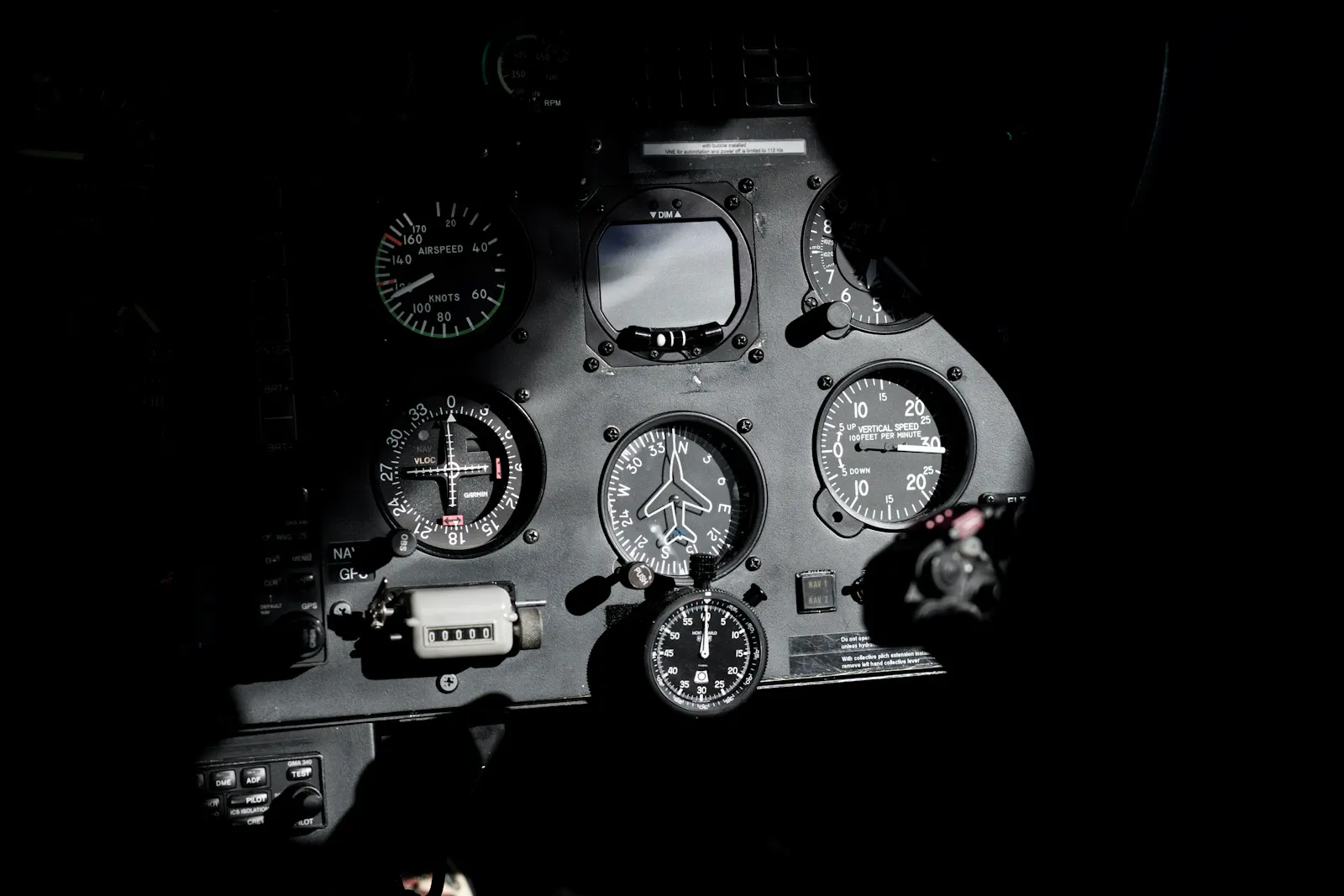
Your altimeter reads 2,500 ft. But 2,500 ft above what? The sea, the runway, or a pressure surface that only exists in textbooks? That question is the whole of altimetry, and it is why the topic keeps coming back in the EASA PPL theory exam. QNH, QFE, 1013, transition altitude, flight level: once you accept that an altimeter is simply a barometer marked in feet, everything falls into place. This guide takes the concepts in order, with worked examples, the pressure and temperature errors, and the classic exam traps.
An altimeter measures pressure, not altitude. What it shows depends on the setting: QFE gives height above the aerodrome, QNH gives altitude above sea level, 1013.25 hPa gives a flight level. Below the transition altitude you fly on QNH; above it, on 1013. Near the surface, 1 hPa is about 27 ft (rounded to 30 ft). Fly towards lower pressure or colder air without resetting and you will be lower than the altimeter shows.
Why Altimetry Matters in the EASA PPL Theory Exam
Under Part-FCL you need 75% in each paper, and altimetry does not have a paper of its own. Instead it turns up in several of them:
- Meteorology: atmospheric pressure and the standard atmosphere;
- Aircraft General Knowledge: how the altimeter and the static system work;
- Air Law: cruising levels and altimeter setting rules;
- Flight Performance and Planning: calculating pressure altitude.
For an overview of all the papers, see our guide to the 9 subjects of the EASA PPL(A) theory exam. The point to remember is that a cross-cutting topic like this one, once understood, pays off in several papers at once.
The Altimeter Is a Barometer
A conventional altimeter contains an aneroid capsule: a small sealed metal box with most of the air removed, which expands as outside pressure falls and contracts as it rises. Linkages turn those movements into needle movements. Outside pressure reaches the instrument through the static vent, a small hole on the side of the fuselage, sheltered from the relative airflow.
The instrument is calibrated in feet according to the International Standard Atmosphere (ISA):
| Parameter | Mean sea level value | Change with altitude |
|---|---|---|
| 🌡️ Temperature | 15 °C | falls by about 2 °C per 1,000 ft |
| 📉 Pressure | 1013.25 hPa | falls by about 1 hPa per 27 ft near the surface |
| 🧭 Tropopause | around 36,000 ft, where temperature levels off at -56.5 °C |
The key consequence: the altimeter shows the altitude the aircraft would be at if the atmosphere were standard and the reference pressure were the one you set. As soon as real pressure or temperature differs from ISA, the reading drifts away from reality. Altimetry is all about knowing which way.
The Subscale
The knob on the altimeter sets, in a small window, the reference pressure from which the instrument measures: the altimeter setting or subscale setting. Increase the value and the indicated altitude increases; decrease it and the indicated altitude decreases. At about 27 ft per hPa, a 10 hPa error is already close to 300 ft.
QFE, QNH and 1013: Three Settings, Three Datums
These are radio codes from the old Q code. The easiest way to learn them is to link each one to its reference surface.
| Setting | What the altimeter reads | On the runway it shows | Typical use |
|---|---|---|---|
| 🛬 QFE | height above the aerodrome | 0 ft | circuits and local flying in some countries |
| 🗺️ QNH | altitude above mean sea level | the aerodrome elevation | navigation below the transition altitude |
| ✈️ 1013.25 hPa | a flight level | the aerodrome pressure altitude | cruise above the transition altitude |
Definitions worth knowing word for word:
- Height: vertical distance measured from a specified datum, usually the aerodrome. You read it with QFE.
- Altitude: vertical distance measured from mean sea level. You read it with QNH.
- Flight level: a surface of constant pressure related to the reference pressure 1013.25 hPa, expressed in hundreds of feet: FL65 is 6,500 ft read with 1013 set.
QNH is the setting you will use most for navigation, for a simple reason: charts give terrain, obstacles and airspace limits above mean sea level. With QNH set, you can compare your altimeter directly with the chart.
💡 Tip: to stop mixing up QFE and QNH, think “F for Field” (the aerodrome, so zero on the ground) and “N for Nautical” (sea level). That is not the official origin of the codes, but it works as a memory hook.
Transition Altitude, Transition Level and Transition Layer
Flying on QNH has a drawback: QNH changes from place to place and hour to hour. If every aircraft set a different QNH, two aircraft showing the same altitude could be at different heights. So above a certain altitude everyone switches to the same setting, 1013.25 hPa.
- Transition altitude (TA): the altitude at or below which vertical position is expressed as altitude on QNH. It is set by each State, can differ between countries and sometimes between areas of the same country, and is published in the national AIP. Always check it for the airspace you will fly in.
- Transition level (TL): the lowest flight level available above the transition altitude. It changes with QNH and is given by air traffic services or the ATIS.
- Transition layer: the airspace between the transition altitude and the transition level. It is not used for level cruise.
The rule for changing the setting is an exam favourite:
| Situation | When to change | New setting |
|---|---|---|
| ⬆️ Climbing | passing the transition altitude | 1013.25 hPa |
| ⬇️ Descending | passing the transition level | QNH |
Within the transition layer, vertical position is therefore expressed as a flight level when climbing and as an altitude when descending.
Why the Transition Level Depends on QNH
Take a transition altitude of 5,000 ft. With a low QNH, the standard pressure surfaces sit lower: FL50 is below 5,000 ft true altitude and cannot be used, so the transition level moves up. With a high QNH, the pressure surfaces sit higher: FL55 may already be comfortably above 5,000 ft. The lower the QNH, the higher the transition level.
Pressure Error: High to Low, Beware Below
This is the most tested situation. You depart with the correct QNH, then fly towards an area of lower pressure without resetting. The altimeter senses lower pressure and interprets it as a higher altitude. Result: it over-reads, and you are lower than you think.
The memory aid: “high to low, beware below”.
Worked Example
You take off where QNH is 1020 hPa and cruise at 3,000 ft indicated. Further on, the regional QNH is only 1008 hPa, but you forgot to reset.
- Setting difference: 1020 - 1008 = 12 hPa.
- Convert: 12 × 27 ≈ 324 ft (360 ft if you use 30 ft per hPa).
- Your subscale is set too high, so the altimeter over-reads by that amount.
- True altitude: 3,000 - 324 ≈ 2,680 ft.
More than 300 ft of terrain clearance has gone, and nothing in the cockpit has changed. That is why you reset regularly with the QNH passed by air traffic services.
Calculating Pressure Altitude
The same logic gives you pressure altitude, which you need for every performance calculation:
Pressure altitude = aerodrome elevation + (1013 - QNH) × 27
Example: aerodrome at 1,200 ft, QNH 1003 hPa. (1013 - 1003) × 27 = 270 ft. Pressure altitude ≈ 1,470 ft: the aerodrome “behaves” as if it were higher. This is the first step towards density altitude, covered in our guide to density altitude and aircraft performance.
Temperature Error: Cold Air Brings You Down
The altimeter assumes ISA temperature. Cold air is denser, so pressure levels are closer together than in the standard atmosphere. To read the same indication, the aircraft has to be lower.
| Colder than ISA | Warmer than ISA |
|---|---|
| 🥶 True altitude lower than indicated | 🥵 True altitude higher than indicated |
| Terrain clearance reduced | Terrain clearance increased |
| A winter and mountain hazard | More favourable over high ground |
A common rule of thumb: the error is about 4% of the height above the station for every 10 °C of deviation from ISA. For example, 3,000 ft above an aerodrome in air 10 °C colder than ISA, you are roughly 120 ft lower than indicated.
For the exam, focus on the direction of the error: low pressure or cold air, the altimeter over-reads. The two effects can add up, and a winter flight over high ground is where the combination bites hardest.
VFR Cruising Levels and the Semicircular Rule
Under the Standardised European Rules of the Air (SERA), VFR flights in level cruise above 3,000 ft above the ground or water, or a higher datum set by the competent authority, must fly a cruising level appropriate to their magnetic track, unless ATC instructs otherwise. This is the semicircular rule:
| Magnetic track | VFR levels | Examples |
|---|---|---|
| ➡️ 000° to 179° | odd thousands + 500 ft | 3,500 ft, 5,500 ft, FL75, FL95 |
| ⬅️ 180° to 359° | even thousands + 500 ft | 4,500 ft, FL65, FL85, FL105 |
Below the transition altitude these levels are flown as altitudes on QNH; above it, as flight levels on 1013. Note that it is the magnetic track that counts, not the heading or the true track. If you need a refresher on converting between them, our article on the wind triangle walks through the method.
Your choice of level must also respect VMC minima and airspace limits, which charts often give as altitudes or flight levels. Our guide to VMC minima and airspace classes covers those rules.
Static System Failures
The altimeter depends entirely on the static vent. Exam questions love to ask what happens when it is blocked by ice, insects or water.
| Failure | Altimeter | VSI | ASI |
|---|---|---|---|
| 🧊 Blocked static vent | frozen at the altitude of the blockage | zero | wrong: under-reads in the climb, over-reads in the descent |
| 🔧 Alternate static source inside the cabin | reads slightly high | briefly shows a climb, then settles | reads slightly high |
Why does the alternate source over-read? In flight, airflow around the fuselage makes the pressure inside an unpressurised cabin slightly lower than true static pressure. The altimeter interprets that lower pressure as a higher altitude. The aircraft flight manual gives any corrections to apply.
Classic Exam Traps
- “On the ground with QFE set, the altimeter reads?” Zero. With QNH, it reads aerodrome elevation.
- “Flying towards lower pressure without resetting, true altitude is?” Lower than indicated.
- “Air colder than ISA, true altitude is?” Lower than indicated.
- “When do you set 1013 in the climb?” Passing the transition altitude. In the descent, set QNH at the transition level.
- “QNH falls: what happens to the transition level?” It rises.
- “You increase the subscale by 10 hPa: indicated altitude?” It increases by roughly 270 to 300 ft.
- “What does FL65 mean?” 6,500 ft read with 1013.25 hPa set, not an altitude above sea level.
- “Magnetic track 220°, above 3,000 ft AGL: VFR level?” Even thousands + 500: 4,500 ft, FL65 and so on.
These pairings stick best with short, regular reviews. Our article on spaced repetition explains how to lock them in without spending hours on each one.
Checklist: Are You Ready on Altimetry?
| ✅ I can… | Quick check |
|---|---|
| Explain what an altimeter measures | Pressure, through the aneroid capsule and static vent |
| Give the ISA values | 1013.25 hPa, 15 °C, about -2 °C per 1,000 ft |
| Link QFE, QNH and 1013 to their datum | Aerodrome, sea level, standard surface |
| Explain TA, TL and the transition layer | When to change setting climbing and descending |
| Correct a setting error | About 27 ft (or 30 ft) per hPa |
| State the direction of pressure and temperature errors | Low pressure or cold: lower than indicated |
| Choose a VFR cruising level | Magnetic track, odd or even + 500 ft |
| Describe a blocked static vent | Altimeter frozen, VSI at zero |
If any line gives you trouble, that is the signal to revisit it before the exam. With AltiPrep, you can practise exam-style questions with an explanation after every answer, review definitions with spaced-repetition flashcards, and track your progress paper by paper with mock exams.
What Altimetry Changes in the Cockpit
In the circuit, altimetry can feel abstract. It becomes very real on your first cross-countries. Before every flight, set QNH and check that the altimeter reads aerodrome elevation: a large difference should make you suspicious. En route, reset every time you are given a new QNH. Before climbing through the transition altitude, prepare the change to 1013, and on the way down, return to QNH before comparing your altitude with the terrain.
Above all, keep generous terrain clearance in winter: cold air and low pressure often come together, and both work against you. For an overall study plan, our guide on how to pass the EASA PPL theory exam first time will help you organise your revision.
Key Takeaways
- An altimeter is a barometer: it measures pressure and converts it to feet using the standard atmosphere.
- QFE: height above the aerodrome (zero on the ground). QNH: altitude above sea level. 1013.25 hPa: flight level.
- Climbing, set 1013 at the transition altitude; descending, set QNH at the transition level, which rises when QNH falls.
- Near the surface, 1 hPa is about 27 ft (often rounded to 30 ft).
- Low pressure or cold air: the altimeter over-reads and you are lower than you think.
- Above 3,000 ft AGL in VFR: magnetic track 000 to 179, odd + 500; 180 to 359, even + 500.
Further reading:
- The 9 Subjects of the EASA PPL(A) Theory Exam Explained
- Density Altitude and Aircraft Performance: EASA PPL Guide
- VMC Minima and Airspace Classes Explained: EASA PPL Guide
- The Wind Triangle Explained: Heading, Drift and Groundspeed
Happy studying, and blue skies!
Frequently asked questions
What is the difference between QNH and QFE?
With QFE set, the altimeter shows height above the aerodrome, so it reads zero on the runway. With QNH set, it shows altitude above mean sea level, so on the ground it reads the aerodrome elevation. QNH is the standard setting for navigation below the transition altitude, because charts give terrain and obstacle elevations above sea level.
Why do pilots set 1013 hPa above the transition altitude?
Above the transition altitude everyone sets the same reference pressure, 1013.25 hPa, and flies flight levels, which are surfaces of constant standard pressure. Because all aircraft use the same setting, vertical separation stays consistent even when the surface pressure varies from one region to another.
What does "high to low, beware below" mean?
If you fly towards lower pressure without resetting the altimeter, it reads higher than your true altitude, so you are lower than you think and closer to the terrain. The same logic applies to temperature: in air colder than standard, your true altitude is lower than the indicated altitude.
How many feet is 1 hPa?
Close to sea level, 1 hPa corresponds to about 27 ft, often rounded to 30 ft for quick mental arithmetic. The value increases with altitude because the air becomes less dense. In the exam, use the figure given in the question or the one taught in your training material.
What is the transition level?
The transition level is the lowest flight level available for use above the transition altitude. It depends on the current QNH and is given by air traffic services or the ATIS. Between the transition altitude and the transition level lies the transition layer, which is not used for level cruise.
Is altimetry part of the EASA PPL theory exam?
Yes, and it appears in several papers: Meteorology for pressure and the standard atmosphere, Aircraft General Knowledge for how the altimeter works, Air Law for cruising levels, and Flight Performance and Planning for pressure altitude. It is a cross-cutting topic that earns marks across the whole exam.